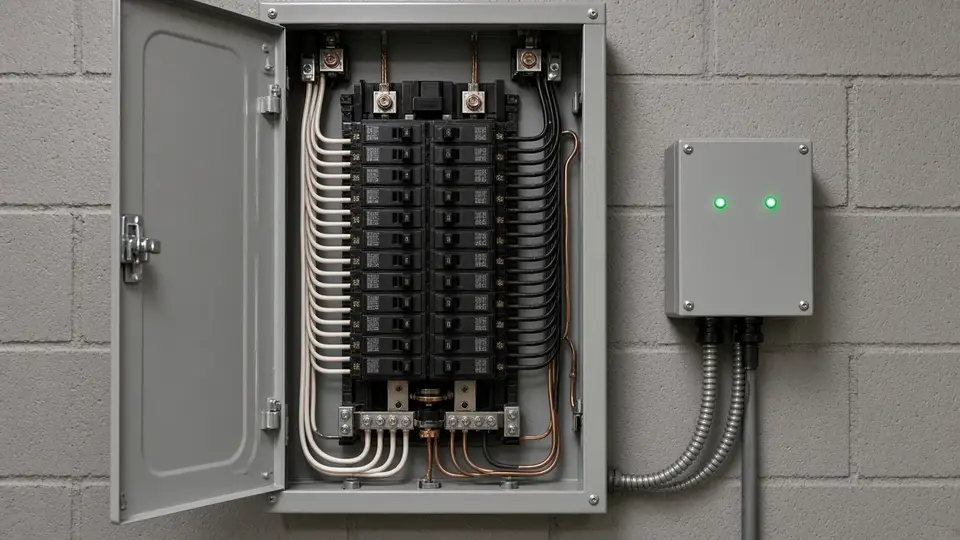
Short answer: A whole-house surge protector is a device installed at your electrical panel or meter that limits voltage spikes before they reach the circuits in your home. It protects things a plug-in strip cannot, like the HVAC system, water heater controls, range, washer and dryer, and hard-wired lighting. It works best paired with plug-in protectors at sensitive electronics. Whether code requires one depends on where you live and the work being permitted, and many homeowners add one during a panel upgrade, after a lightning-related failure, or when they install expensive equipment.
Here is how they work, who benefits most and what to know before you add one.
What a whole-house surge protector does
A power surge is a short spike in voltage, lasting a tiny fraction of a second. Surges come from outside the house, like lightning nearby or switching on the utility lines, and from inside, when large motors and compressors cycle on and off. Small, repeated surges can wear down electronics over time. A big one can ruin them at once.
A whole-house surge protector, also called a surge protective device or SPD, sits between incoming power and your circuits. When voltage rises past a set level, it diverts the extra energy to ground so it does not travel through your wiring to everything plugged in or hard-wired.
Whole-house vs plug-in surge protectors
Surge protective devices are grouped by where they are installed:
- Type 1: installed on the line side of the main breaker, such as at the meter or service equipment.
- Type 2: installed on the load side of the main breaker, usually at the main panel. This is the most common whole-house surge protector in homes.
- Type 3: point-of-use protection, like quality plug-in surge strips at a TV, computer or home office.
A whole-house unit handles the large surges coming into the house and protects hard-wired equipment. Plug-in protectors handle what gets through and the smaller surges created inside the home. The two work as layers. One does not replace the other.
Also remember that cable, internet and phone lines can carry surges into the house too. If you are protecting a home office or entertainment setup, ask about protecting those lines as well.
Who benefits most from a whole-house surge protector
- Homes with a lot of hard-wired or high-value equipment: heat pumps and HVAC systems, smart appliances, induction ranges, tankless water heaters.
- Homes with an EV charger, solar, a battery system or a standby generator.
- Homes in areas with frequent thunderstorms. The Carolinas see plenty of them in the warmer months.
- Anyone who has already lost an appliance, a control board or electronics to a surge.
- Homeowners doing a panel upgrade. Adding a surge protector while the panel is being worked on is often simpler than doing it as a separate job.
Is a whole-house surge protector required in SC or NC?
Whether one is required depends on the electrical code your town enforces for your type of home when the work is permitted. Codes are changing in both states, so ask your electrician or the local permit office.
Sources: South Carolina Building Codes Council: adopted codes (SC LLR), North Carolina Office of State Fire Marshal: State Electrical Code and Interpretations
Either way, a whole-house surge protector is a reasonable choice for many homes.
What a whole-house surge protector does not do
- It does not make a home lightning-proof. A direct strike carries far more energy than any home device is built to stop.
- It does not replace good grounding and bonding. A surge protector depends on a sound grounding system to work.
- It does not last forever. Surge protectors wear out as they absorb surges. Many units have an indicator light that shows whether protection is still active. Check it after a big storm.
What affects the cost
There is no single price, because the job depends on your house. The main factors are:
- Which type of device and where it is installed: at the panel, at the meter or both.
- Whether your panel has room for the device and is in good condition.
- The condition of your grounding and bonding. If it needs correcting, that adds to the scope.
- Whether it is installed on its own or added during a panel upgrade.
- Any protection added for cable, internet or phone lines.
The best way to get a real number is an on-site estimate. At J&E Electric, our estimator comes out, looks at the job and gives you a written price. Nothing starts until you approve it.
When to call a licensed electrician
Call right away if you notice:
- A burning smell, scorch marks or melted parts at the panel or an outlet after a storm
- Breakers that will not stay reset after a surge
Schedule a visit when:
- An appliance, control board or electronics failed after a storm
- You are planning a panel upgrade, EV charger, generator or solar
- Your existing surge protector’s indicator light is out or shows a fault
Installing a whole-house surge protector means working inside the panel, including parts that stay energized with the main breaker off. Leave it to a licensed electrician.
Surge protection in Rock Hill, Fort Mill and the Charlotte area
J&E Electric has been working in Rock Hill since 2008. We are licensed in South Carolina (M110118) and North Carolina (27147-U), and insured. We work in homes across York, Chester and Lancaster counties in South Carolina and Mecklenburg and Union counties in North Carolina, including Rock Hill, Fort Mill, Tega Cay and Charlotte. A whole-house surge protector is one of the add-ons you can choose with our electrical panel upgrade service. If you are not sure your panel is ready, read the signs your panel needs an upgrade.
If you want to protect the equipment in your home, request an estimate. Tell us what is going on and where, and we will set a time to come and look. You can also call (803) 965-8714, Monday to Friday, 8 am to 5 pm.
Request an estimate · Related service: Residential Electrical Services